Modality Matters: How AI feedback presentation shapes user experience in a golf coaching study
A within-subjects study (N = 10) comparing three AI feedback modalities — text, text + visual, and text + visual + audio — for novice golfers.
Setup
Golf is growing globally, but retention is not — only 25% of first-time players continue past their first year. AI coaching tools have emerged as a possible answer, and the technical challenge of detecting swing faults from video has largely been solved. But how the resulting feedback should be delivered to novice users is essentially unstudied.
This study asked how three AI feedback modalities — text only, text with visual annotations, and text with visual annotations and audio — affect novice golfers' perceptions of the coaching they receive. Novices were the target population because feedback presentation matters most for users who don't yet have the mental models to fill in gaps themselves — and because they're also the population most likely to be reached by consumer AI coaching tools as they scale.
Approach
A within-subjects design (N = 10) let each participant experience all three conditions on the same coaching content — isolating the effect of modality from any effect of the feedback itself. This matters: without holding content constant, differences between conditions could reflect what was said rather than how it was presented.
Method
Participants
Ten participants (ages 19–38, M = 24.1) were recruited as novice recreational golfers — no competitive playing experience, and most with no formal instruction. Baseline trust in AI systems was moderate (M = 4.6/7), and most participants described themselves as moderately familiar with AI tools, giving me a middle-of-the-road baseline against which to compare condition-level trust ratings.
Conditions
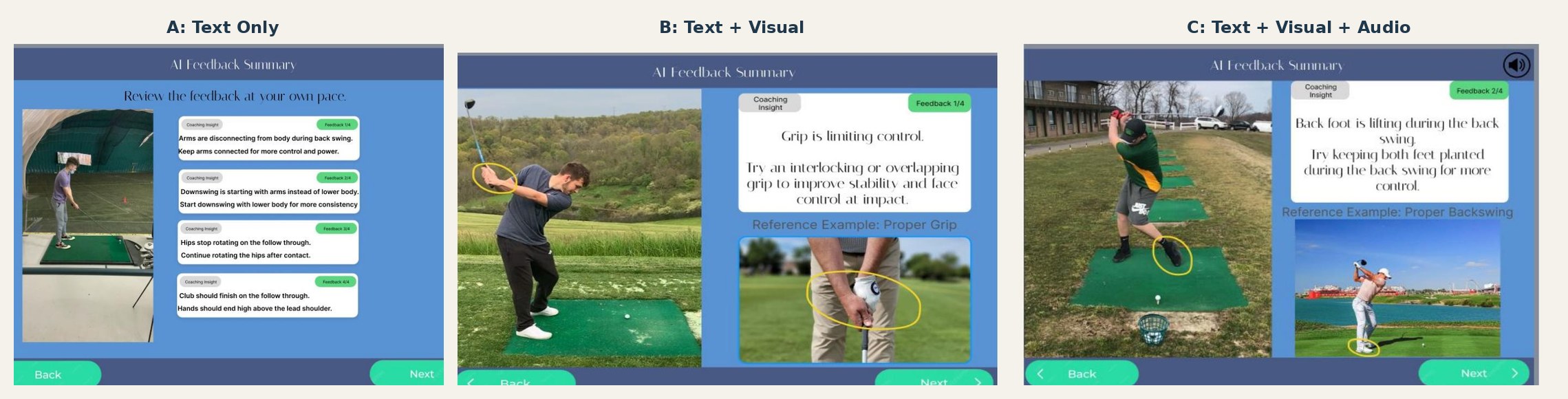
The three conditions were built as interactive Figma prototypes, each presenting the same four-card coaching feedback for one of two swing videos. The design was additive: Condition A provided text alone, Condition B layered visual annotations (arrows, highlights) on top of that text, and Condition C added synchronized audio narration on top of the visuals. This structure meant each comparison isolated the incremental contribution of a single added modality.
Procedure
A session began with a pre-study questionnaire on demographics, golf experience, and baseline AI trust. Participants then completed two video blocks: each block involved watching one golf swing video, experiencing all three feedback conditions on it (in a counterbalanced order — ABC, BCA, or CAB), and rating each condition immediately after. After both video blocks, participants completed a post-study questionnaire with forced-choice preference items and open-ended prompts. Sessions averaged 32 minutes.
Measures
Participants rated each condition on four dimensions using 7-point Likert scales: trust, clarity, helpfulness, and confidence — with items like "I trust the feedback provided by this system" and "I feel confident applying this feedback." Multi-item constructs were averaged into composite scores. After both video blocks, forced-choice preferences (most preferred, most trustworthy, most clear, most useful) and open-ended responses were captured for triangulation with the quantitative ratings.
Analysis
Because the sample was small (N = 10) and the ratings were ordinal Likert data, I used non-parametric tests throughout. Friedman tests examined the overall effect of modality on each dependent variable; where a Friedman test was significant, Wilcoxon signed-rank tests compared conditions pairwise, with a Bonferroni-corrected significance threshold of α = .017. Open-ended responses were analyzed inductively for themes that could triangulate or complicate the quantitative findings.
My role
This was a solo project. I designed the study, built the three Figma prototypes, recruited and ran all ten participants, conducted the statistical and thematic analysis, and wrote the final report under the supervision of Dr. Roshan Peiris and Dr. Garreth Tigwell. Every methodological and design decision described in this case study is my own.
Findings
Multimodal feedback outperformed text-only feedback across all four measures — but not in the way I expected. Different modalities specialized in supporting different outcomes, and layering audio on top of visuals produced diminishing returns rather than compounding gains.
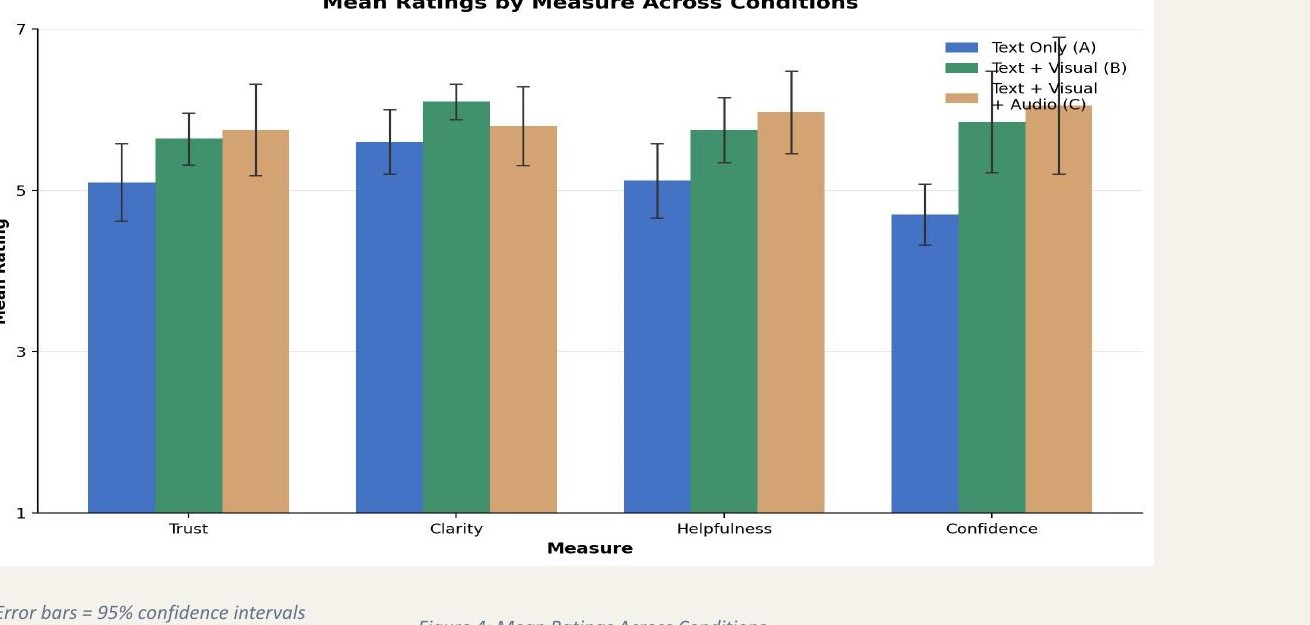
Trust ratings increased steadily from Condition A (M = 5.10) to B (M = 5.64) to C (M = 5.75). The Friedman test was significant (χ²(2) = 7.20, p = .027), but no pairwise comparison survived Bonferroni correction — a likely consequence of the small sample. The qualitative data was much sharper: 7 of 10 participants selected Condition B as the most trustworthy format, describing the visual annotations as making the system feel "believable" and "more real."
Clarity told the study's cleanest quantitative story. Condition B produced the highest mean rating (M = 6.10) and, more strikingly, the lowest variance of any measure in the study (SD = 0.30) — near-consensus that visual annotations made the feedback easy to understand. The Friedman test was significant (χ²(2) = 7.74, p = .021). Adding audio to visuals slightly reduced clarity, consistent with the redundancy effect in multimedia learning: duplicating verbal information across channels can add processing cost without adding comprehension.
Helpfulness showed a divergence between the numbers and the preferences. Aggregate ratings favored Condition C, but the Friedman test did not reach significance (p = .072). The forced-choice data, however, was decisive: 6 of 10 participants selected C as "most useful" — the strongest single preference on any measure in the study. Several participants attributed this to the layered feedback feeling like "real coaching."
Confidence produced the largest and most robust effect. Ratings rose sharply from Condition A (M = 4.70) to Condition B (M = 5.85), and the A vs. B pairwise comparison survived Bonferroni correction (p = .016) — the only pairwise comparison in the entire study to do so. But B vs. C was essentially flat (p = .633): once visuals had closed the interpretive gap for participants, audio added nothing further on this dimension.
The forced-choice preferences reinforced the asymmetric pattern. Condition B dominated on trust (7/10) and tied for the top spot on clarity and overall preference (5/10 each). Condition C was dominant only on usefulness (6/10). Condition A received exactly one vote in every category — from the same participant — while no one else chose text-only as their top pick on any dimension.
The insight
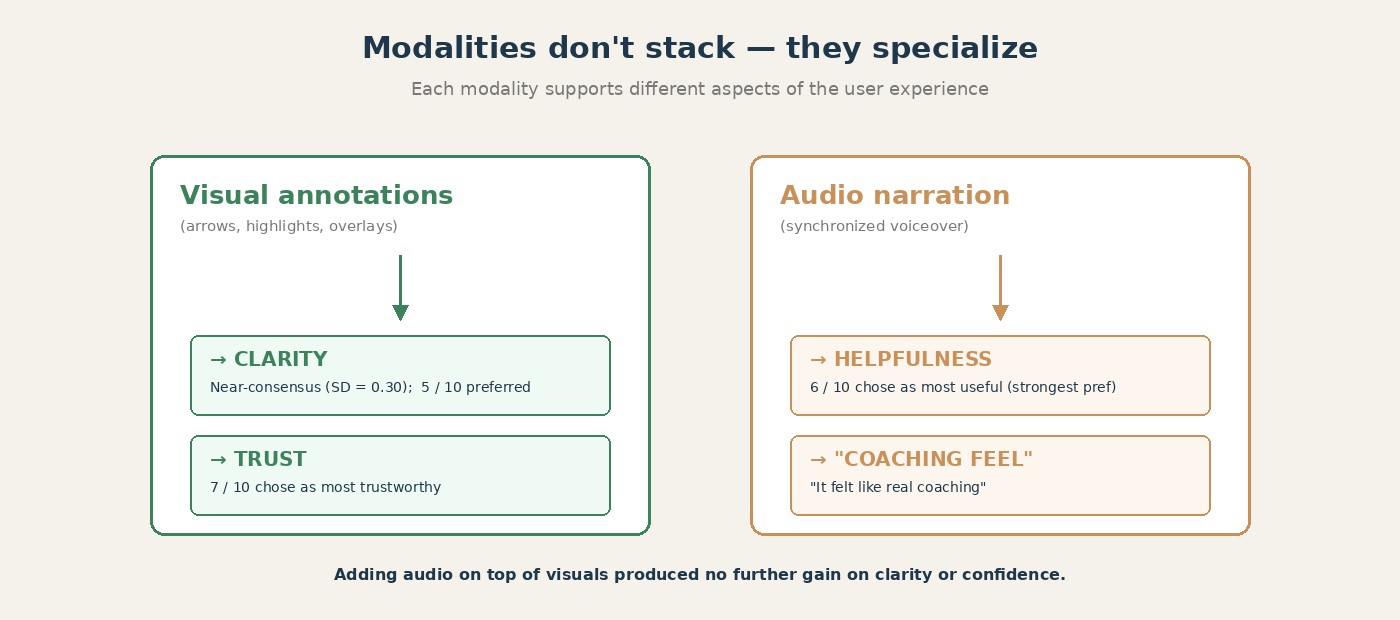
Viewed together, the four measures pointed to something more specific than "multimodal is better." Visual annotations produced the largest and most consistent effects on clarity and trust — with clarity in Condition B showing striking near-consensus. Audio, by contrast, was where participants located the feeling of being coached: it was disproportionately chosen as the most useful format, even where its aggregate rating did not reach statistical significance.
But the moment those modalities were layered on top of one another, the gains stopped compounding. Adding audio to visuals produced no further improvement on any measure — and on clarity, slightly reduced it. This wasn't a case of multimodal being universally better. It was a case of each modality doing a specific job well, with diminishing returns when they overlapped.
Design implications
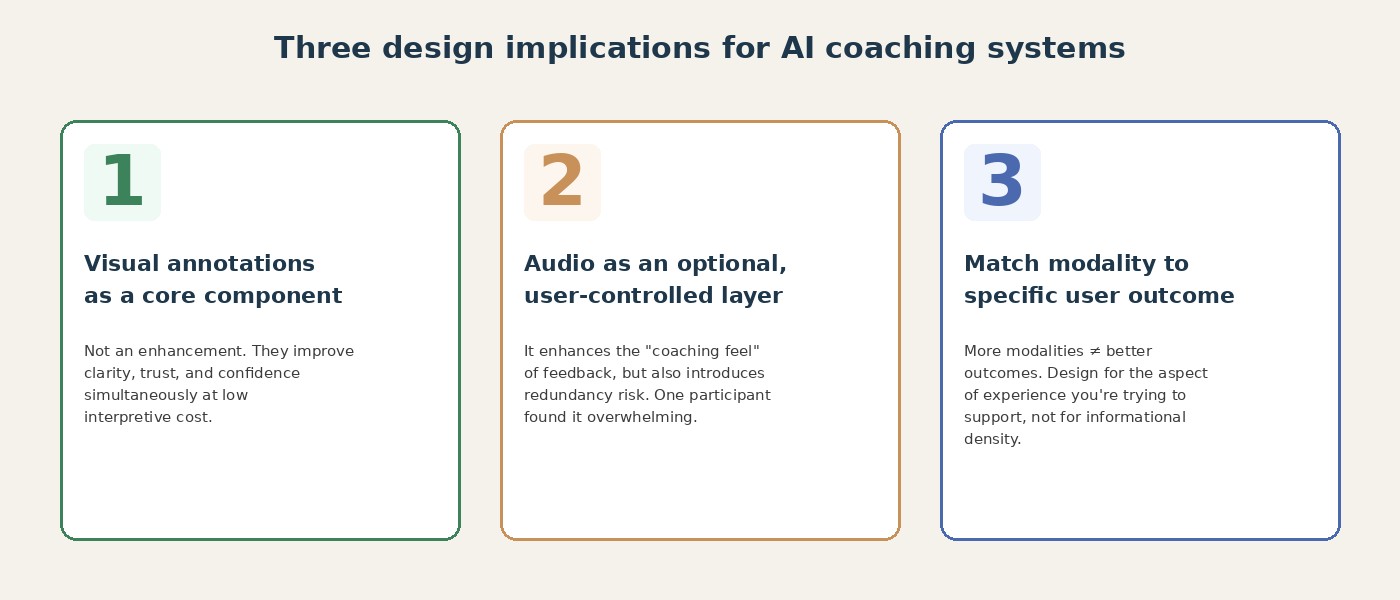
These findings support three design implications for AI coaching systems. They aren't about adding more features — they're about matching modality choices to the specific outcomes those systems are trying to support.
Reflection
The clearest limitation of this study is sample size. N = 10 is defensible for a formative within-subjects study using non-parametric tests, but it left genuinely interesting patterns — like the strong forced-choice preference for audio on helpfulness — below the threshold that inferential statistics could confirm. Counterbalancing was also imperfect: the 4-3-3 distribution across ABC/BCA/CAB sequences and the reuse of each participant's sequence across both video blocks are both places a fuller Latin-square design would have been cleaner. If I ran this again with more time and participants, those are the first two things I'd change.
The clearest takeaway for me was how much of the user's experience of an AI system lives in the presentation layer, not the model layer. The coaching feedback in this study was identical across all three conditions — same words, same corrections, same suggestions. Everything that changed in participants' trust, clarity, and confidence ratings came from how that content was delivered, not what it said. That's a principle I'll carry forward in any research or design work where AI outputs meet real users: the delivery is the design.